Disclaimer: This calculator provides an estimate only and does not represent official NHS sick pay. Actual payments may vary based on NHS policy, contract terms, and individual circumstances.
NHS Sick Pay Introduction
Unexpected illness can turn life upside down, especially when income security becomes uncertain. For healthcare professionals, understanding sick pay rules is essential to reduce stress during recovery. Many staff members struggle to track how much paid leave remains or what happens after long absences. That’s where clarity matters most.
This guide explains how NHS sickness pay works, who qualifies, and how planning ahead can protect your income. Whether you’re managing a short absence or preparing for extended recovery, knowing your entitlement helps you focus on health instead of finances. With policy changes and updated rules, staying informed has never been more important.
NHS Sick Pay 6 Months Calculator
The NHS Sick Pay 6 Months Calculator helps NHS employees estimate their pay during extended sickness based on service length and policy rules. It gives a clear view of entitlement, making financial planning easier during recovery.
What Is NHS Sick Pay 6 Months ?
NHS employees with five years of continuous service are typically entitled to six months’ full pay followed by six months’ half pay under NHS Sick Pay Entitlement 2026. This forms part of your long-term sick pay entitlement,
designed to provide stability during serious illness. The entitlement depends on your continuous service, your absence record, and how much leave has already been used within a rolling year. Understanding this structure prevents surprises and supports informed decisions during extended illness.
NHS Sick Pay 6 Months Calculation (Step-by-Step)
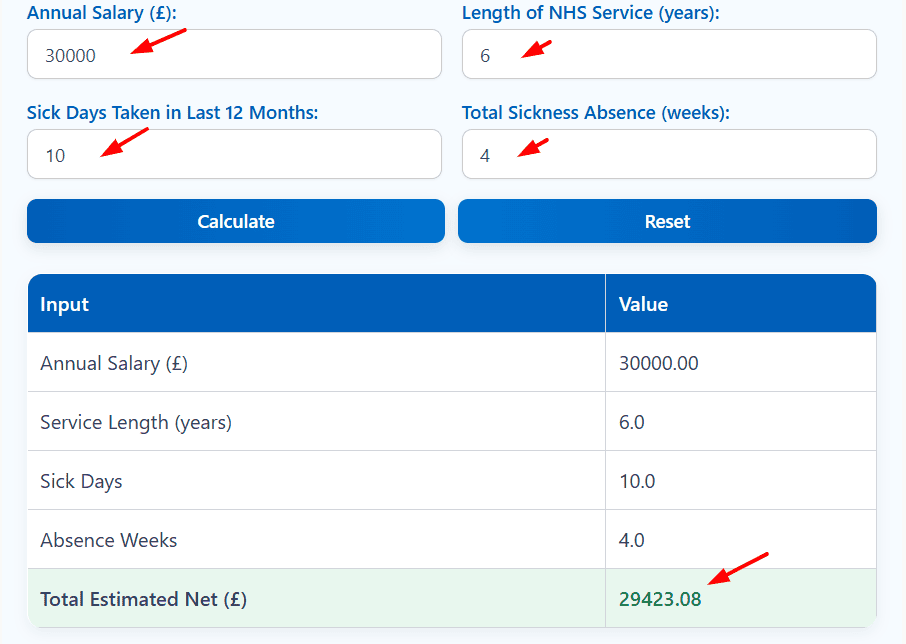
Suppose: An NHS employee earns £30,000 per year, has over 5 years of continuous service, has taken 10 sick days in the last 12 months, and has been absent for 4 weeks due to illness — what would their estimated sick pay be?
Step 1: Check Length of Service Eligibility
The employee has completed more than five years of continuous NHS service, which makes them eligible for extended sick pay under NHS sick pay rules.
Step 2: Apply Sick Pay Entitlement Rules
With this service length, the employee qualifies for up to six months of full pay followed by six months of half pay, subject to sickness history and remaining entitlement within the rolling 12-month period.
Step 3: Review Sickness Record
The calculator checks the 10 sick days already taken in the last 12 months and confirms that the total absence of 4 weeks does not exceed the available entitlement.
Step 4: Salary Impact During Absence
Since the sickness period is within the full-pay entitlement, the salary is largely protected, with minor adjustments applied based on total absence duration.
Step 5: Net Pay Estimation
After applying service length, sickness duration, and entitlement rules, the calculator estimates the net income during the sickness period.
Result Shown
Annual Salary (£): 30,000.00
Service Length (years): 6.0
Sick Days Used: 10
Absence Duration: 4 weeks
Total Estimated Net Pay (£): 29,423.08
Notice: This calculator provides an estimated sick pay figure based on NHS Agenda for Change sick pay rules. Actual sick pay may vary depending on NHS Trust policies, individual employment contracts, previous sickness history, and payroll deductions.
Common Scenarios and Planning Ahead
Many staff rely on tools like the NHS 12-Month Rolling Sickness Calculator to track time off accurately across a rolling 12-month basis. Once you know the full-pay and half-pay entitlement remaining, use the NHS Sick Pay Calculator to estimate the payment for your salary, working pattern and absence duration.
For tailored insight, the NHS Sick Pay Length of Service Calculator considers role history and service gaps. Planning ahead ensures financial stability even when facing periods of sickness or uncertainty about NHS sick pay after 6 months.
Why Understanding NHS Sick Pay Matters ?
Understanding NHS sick pay protects more than just income — it supports wellbeing. Under Agenda for Change policies, staff receive structured financial support during illness, but misunderstandings are common. Many overlook how sickness history within the previous 12 months affects eligibility. Contractual full-pay and half-pay support can be examined separately with the NHS Enhanced Sick Pay Calculator.
Once your paid sick leave entitlement ends, alternatives like Employment and Support Allowance (ESA) may apply. Awareness also helps locally employed staff and bank staff, who may have different terms under Agenda for Change. Knowing your rights empowers better decisions and reduces stress when health must come first.
Common Mistakes to Avoid
A frequent error is assuming six months’ sick pay is automatic for all roles. Another mistake is ignoring NHS sick pay length of service rules, which can change outcomes significantly. Many staff forget to monitor entitlement using tracking tools or misunderstand how Statutory Sick Pay (SSP) interacts with NHS benefits.
Failing to check official guidance from GOV.UK can also lead to incorrect expectations. Staying informed prevents financial shocks during recovery.
FAQs
Q:1- Who is eligible for NHS sick pay for up to six months?
A:- NHS staff with the required length of continuous service may qualify for extended sick pay, subject to their role, contract terms, and recent absence history.
Q:2- How does the rolling 12-month period affect NHS sick pay?
A:- NHS sick pay is calculated using a rolling 12-month period, meaning previous sickness absences are counted until they fall outside the last 12 months.
Q:3- What happens to income after six months of NHS sick pay?
A:- After the initial period, pay is usually reduced, and eligibility depends on remaining entitlement and service length.
Q:4- Can NHS employees claim other benefits once sick pay ends?
A:- Yes, employees may be able to apply for Employment and Support Allowance or other support depending on their circumstances.
Q:5- Do bank or temporary NHS staff receive the same sick pay?
A:- Bank and some temporary staff often have different sick pay arrangements, which are set out in their individual contracts.
Q:6- Is NHS sick pay the same as Statutory Sick Pay?
A:- NHS sick pay is separate from Statutory Sick Pay and is usually more generous, but eligibility rules differ.
Q:7- Where can I find official NHS sick pay guidance?
A:- Official guidance on sick pay and employment rules is available through GOV.UK and NHS employment policies.