NHS Salary Estimate
Annual Salary: £0
Monthly Pay: £0
Weekly Pay: £0
Hourly Rate: £0
NHS Pay Bands Overview (Band 1 to Band 9)
Starting a career in the UK health system or planning your next move can feel confusing without a clear salary structure. The National Health Service follows a transparent framework that helps employees understand where they stand and how they can grow.
This guide breaks down how pay levels are organised, what influences progression, and how different roles fit into the system. Whether you are entering support services or aiming for leadership, knowing how bands work helps you make informed career decisions,
plan finances better, and avoid common mistakes. Understanding pay clarity is not just about numbers; it’s about recognising value, responsibility, and long-term career direction within healthcare.
What Are NHS Pay Bands Overview (Band 1 to Band 9) ?
NHS Pay Bands are structured salary levels that define earnings across NHS salary bands for non-medical staff. Introduced under Agenda for Change,
this framework ensures fair NHS band pay based on role responsibility, skills, and experience. It includes Band 1, Band 2, Band 3, Band 4, Band 5, Band 6, Band 7, Band 8, and Band 9, offering clarity from entry-level roles to executive leadership.
This structure supports fairness, consistency, and transparency across services while aligning pay with accountability.
NHS Salary Calculation (Step-by-Step)
Suppose: An NHS employee is on Band 5 at the Mid pay point, works full-time (37.5 hours per week), receives Inner London weighting, and has 2 years of progression — what would their estimated salary be?
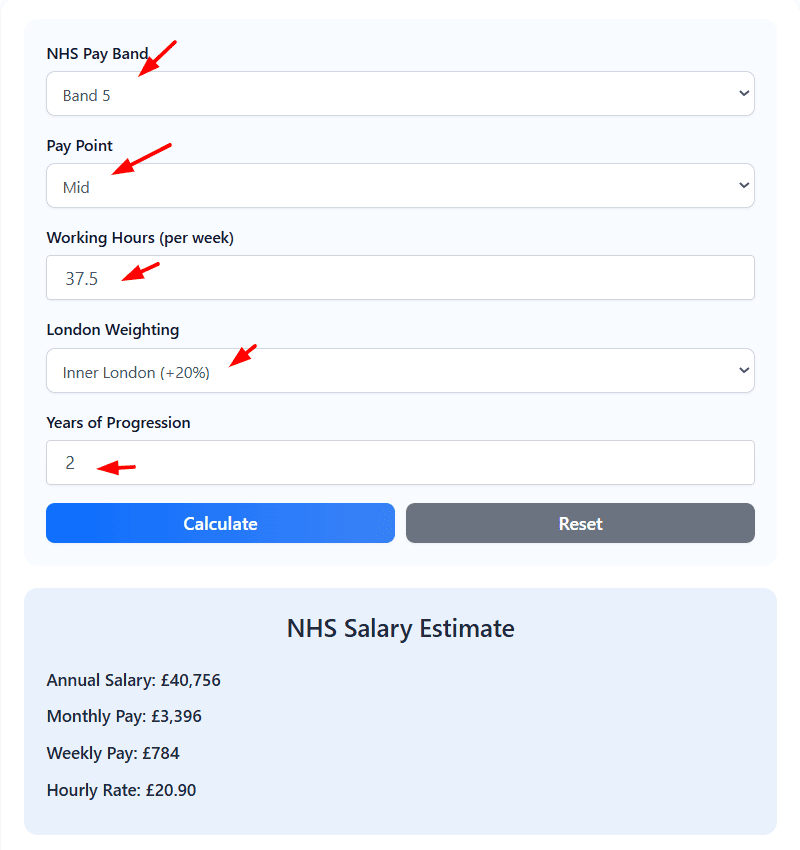
Input Values (Image – Form Filled)
- NHS Pay Band: Band 5
- Pay Point: Mid
- Working Hours (per week): 37.5
- London Weighting: Inner London (+20%)
- Years of Progression: 2 years
Step 1: Base Salary Range (Band 5)
The calculator uses the predefined NHS Band 5 salary range:
- Minimum salary: £28,407
- Maximum salary: £34,581
Step 2: Mid Pay Point Calculation
The Mid pay point represents the midpoint between the minimum and maximum salary:
Base salary
= £28,407 + (50% of the band range)
= approximately £31,494
Step 3: Adding Years of Progression
For 2 years of progression, an incremental increase is applied
based on the band range used by the calculator:
Progression increase: approximately +£2,460
Updated salary: approximately £33,963
Step 4: Working Hours Adjustment
The employee works full-time (37.5 hours per week),
so no pro-rata reduction is applied.
Salary remains: approximately £33,963
Step 5: Applying London Weighting
Inner London weighting adds 20% to the salary:
London weighting amount
= £33,963 × 20%
= £6,793
Final adjusted salary
= £33,963 + £6,793
= £40,756
Result Shown
- Annual Salary: £40,756
- Monthly Pay: £3,396
- Weekly Pay: £784
- Hourly Rate: £20.90
Notice: This calculator provides an estimated salary based on NHS Agenda for Change pay bands.
Actual pay may vary depending on the NHS Trust, job role, local allowances, increments, and contract terms.
How NHS Pay Bands Work in 2026
The system follows the AfC system, which standardises NHS band wages and maintains band wages NHS wide across NHS organisations.
Pay increases are linked to NHS pay progression, performance, and experience rather than negotiation. While England uses this model directly, similar principles apply through HSC bands in other UK health services, ensuring nationwide alignment.

NHS Band Structure by Role Type
Under the NHS Band Structure by Role Type, support roles often begin within Healthcare assistants bands, while clinical pathways show clear nurses band progression.
Many allied health professionals bands span mid to senior levels, and leadership positions fall into senior management NHS bands. This alignment ensures that responsibility and expertise are rewarded consistently.
Common Scenarios and Planning Ahead
Many employees review NHS Pay Bands and Salary Ranges when switching departments, applying for promotions, or relocating. Understanding NHS pay band entry pay and NHS pay band top pay helps with long-term planning,
especially when comparing growth opportunities or budgeting for future commitments. Tools like the internal NHS Salary Calculator can help project earnings realistically.
NHS Pay Bands and Salary Ranges
| NHS Pay Band Level | Typical Roles | Responsibility Level |
|---|---|---|
| Entry-Level Support | Domestic assistants, housekeeping roles | Basic support duties with close supervision |
| Early Support Roles | Porters, trainee healthcare assistants | Routine patient and facility support tasks |
| Intermediate Support | Therapy assistants, clerical officers | Skilled assistance and administrative responsibilities |
| Developing Practitioners | Assistant practitioners, administrative supervisors | Supervision, coordination, and specialised support |
| Clinical Professionals | Staff nurses, radiographers, midwives | Direct patient care and professional accountability |
| Senior Clinical Staff | Senior nurses, physiotherapists, experienced specialists | Advanced clinical decision-making and mentoring |
| Advanced Practice Roles | Advanced practitioners, ward managers | Service leadership and operational oversight |
| Senior Leadership | Senior clinical leaders, NHS managers, lead pharmacists | Strategic planning and departmental leadership |
| Executive Leadership | Directors, senior NHS executives | Organisational governance and system-wide responsibility |
Why NHS Pay Bands Matter ?
Understanding Why NHS Pay Bands Matter is essential for anyone working in healthcare. These bands promote equal pay NHS principles by ensuring people in similar roles receive comparable salaries regardless of location.
They support transparent career progression, allowing staff to see clear steps for advancement. By maintaining consistent NHS salary standards, the system protects the integrity of the NHS workforce and builds trust between employees and employers.
It also simplifies workforce planning and budgeting while reinforcing fairness across roles and regions.
How Pay Progression Works ?
How Pay Progression Works depends on movement through NHS pay points, guided by annual appraisals, length of service, and performance outcomes. Beyond band limits, increases may occur through promotions or national NHS pay awards that adjust salaries across the system.
Common Mistakes to Avoid
A frequent error is assuming automatic jumps between bands without meeting competency criteria. Others misunderstand regional differences in NHS pay across the UK or overlook how NHS Trusts Agenda for Change policies apply locally.
Not checking role-specific data like Band 5 NHS Salary, Band 6 NHS Salary, or using the NHS Band 6 Salary Calculator can also lead to unrealistic expectations.
Related NHS Salary Calculators:-
- What Is the NHS Salary Calculator?
- Comparing NHS Band 5 vs Band 6 Pay: Key Salary Differences
- NHS Band 6 Salary Calculator
- NHS Sick Pay Calculator
- NHS 12th Month Rolling Sickness Calculator
FAQs
Q1: Can NHS pay change every year?
Yes, NHS salaries can change through national pay reviews and updated NHS pay scales, usually announced after government negotiations.
Q2: Does Band 8 pay apply equally to all senior positions?
Not exactly—Band 8 salaries differ depending on the role and responsibilities, with sub-bands reflecting levels from entry leadership to senior management.
Q3: What does Band 8a mean in practice?
Band 8a typically reflects senior professional expertise with limited strategic or organisational responsibility compared to higher Band 8 levels.
Q4: Are there multiple levels within Band 8?
Yes, Band 8 is divided into sub-bands up to Band 8d, with each level reflecting increased leadership, responsibility, and accountability.
Q5: Does experience outside the NHS count?
Relevant external experience may influence starting pay points, but final placement depends on role evaluation and individual NHS Trust policies.
Q6: Where can I check official NHS pay guidance?
You can review the latest NHS pay frameworks on the official NHS website at nhs.uk.
Q7: Can I move bands without changing jobs?
Progression usually occurs within the same band; moving to a higher band typically requires a role change or promotion.